
US President Donald Trump is set to visit China for talks with President Xi Jinping on trade, global issues, and the Gulf war. The visit aims to address trade frictions and other key issues, with high expectations for progress.

US President Donald Trump received a red carpet welcome in Beijing for talks with Chinese President Xi Jinping on trade, the Iran war, and other key issues. The visit underscores the importance both nations place on their relationship amid ongoing tensions.
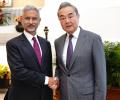
China promised to address three key concerns of India, the sources said.

Chinese President Xi Jinping has arrived in Pyongyang for his first official visit in seven years, meeting with North Korean leader Kim Jong-un to reaffirm their long-standing friendship and pledge further development of bilateral relations amidst Pyongyang's deepening military ties with Moscow and China's assertions against Japan's 'new militarism'.

Russian President Vladimir Putin will attend the BRICS summit in New Delhi on September 12-13, according to a presidential aide.

The United States has warned China against escalating tensions as Taiwan detected multiple Chinese naval vessels, official ships and balloons operating around the island amid Beijing's large-scale live-fire military drills.
After constantly threatening China with 100% plus tariffs, US President Donald John Trump was all chummy when he met Chinese President Xi Jinping at Gimhae international airport during the Asia-Pacific Economic Cooperation summit in Busan, South Korea, on Thursday, October 30, 2025.

Apple Inc, which had planned to shift only 10 per cent of its global production base from China to India with respect to iPhones at the end of FY26, is currently churning out one out of every four iPhones in the world from India.

India and China have reached new common understandings agreeing to conduct normalised management and control of the boundary during Foreign Minister Wang Yi's visit to New Delhi, Beijing said.

US President Donald Trump will visit China from May 13 to 15 at the invitation of President Xi Jinping. The visit occurs amidst global tensions, including the war in West Asia and trade disputes between the US and China. Discussions are expected to cover China-US relations, world peace, and economic issues.
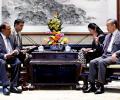
India and China are expected to discuss new confidence-building measures for durable peace and tranquillity along their contested border during Chinese Foreign Minister Wang Yi's two-day visit to India. The visit is seen as an effort to rebuild relations after the Galwan Valley clashes.

Ambassadors of the Quad nations, consisting of the United States, India, Australia and Japan, held a rare publicised meeting in Beijing.
"The external affairs minister will be visiting Moscow to attend the SCO Council of Foreign Ministers' meeting which is scheduled on September 10," spokesperson in the Ministry of External Affairs Anurag Srivstava said at an online media briefing.
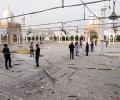
Chinese Foreign Minister Wang Yi stated that China mediated tensions between India and Pakistan, a claim disputed by India which maintains that the matter was resolved bilaterally.

US President Donald Trump and Chinese President Xi Jinping met in Beijing to discuss a range of issues, including trade frictions and the war in Iran.

Officials from Pakistan, Afghanistan, and China are meeting in Urumqi to discuss regional security concerns and potential confidence-building measures.

'Uncertainty level A in the morning, uncertainty level B in the afternoon. If I answer about tariff rates now, I'll be outdated by the evening.'

US President Donald Trump threatened to bomb Iran if a deal is not reached before the ceasefire ends, while Pakistan urged both sides to extend the truce and pursue diplomacy.

'Nepal today is far more aware, self-confident, aspirational, and assertive.' 'India's policy so far has not been geared to this shift. It is time to redraw our Nepal strategy.'
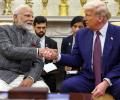
The PM's overseas visits in 2025 picked up sharply after May, particularly following Operation Sindoor.

The Bharatiya Janata Party on Tuesday said it held a formal meeting with a Chinese delegation openly, given the "improved" relations between New Delhi and Beijing, unlike the Congress which, it alleged, "secretly" signed a memorandum of understanding with the neighbouring country's ruling party.

The Beijing summit may have reduced immediate diplomatic uncertainty, but it did not resolve the deeper structural contest between the United States and China. That contest appears likely to define the coming decade, notes Varun Arya.

'When we start describing somebody as an enemy that is the start of politics and emotion after which no business can take place.' 'We need to get out of this, allow Indian businessmen to do business with China.'

US President Donald Trump and Chinese President Xi Jinping began a crucial two-day summit in Beijing on Thursday, with both leaders signalling a desire to stabilise relations between the world's two biggest economies despite deep disagreements on trade, Taiwan, technology and security issues.

Dr Jaishankar, right, appears to look away from Wang Yi, second from right, at the East Asia Summit Foreign Ministers Meeting in Jakarta, Indonesia, Friday, July 14, 2023.
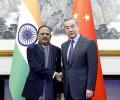
He said that in recent times, based on the important consensus reached by the leaders of the two countries, China and India have maintained close communication on the border situation through diplomatic and military channels and achieved great progress.

Two senior Chinese ministers attended India's Independence Day reception in Beijing, signaling a potential improvement in relations ahead of Prime Minister Modi's expected visit to China for the Shanghai Cooperation Organisation summit.

If one has to compare the tenures of the two prime ministers one must credit Nehru with laying the foundations on which Modi is building a grand edifice, asserts Colonel Anil A Athale (retd).
The announcement on expansion of CPEC was made following a meeting among Chinese Foreign Minister Wang Yi, his Pakistani counterpart Ishaq Dar and Afghanistan's Acting Foreign Minister Amir Khan Muttaqi in Beijing, according to a Pakistani readout.

Chinese Foreign Minister Wang Yi said that it is imperative for the two sides to view each other as partners and opportunities rather than rivals or threats, and invest their valuable resources in development and revitalisation.

China and Pakistan concluded their strategic dialogue, reiterating their opposition to unilateral actions in South Asia and discussing Kashmir, Afghanistan, and trilateral cooperation.

Since June, India's ministry of external affairs has intensified its diplomatic calendar, hosting several heads of state and government, foreign ministers, and key trade delegations.

China has expressed surprise over India's clarification regarding its stance on Taiwan, following reported comments by External Affairs Minister S Jaishankar. Beijing claims India's position is inconsistent with facts and undermines China's sovereignty.

Pakistan's Prime Minister Shehbaz Sharif has offered to mediate between the US and Iran to de-escalate the ongoing conflict in West Asia, following a joint US-Israel attack on Iran. Sharif has been in contact with Saudi Arabia, the UAE, and other nations to promote dialogue and diplomacy.
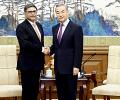
The Chinese Defence Ministry has stated that the Indian and Chinese militaries are implementing the resolutions to end the standoff in eastern Ladakh in a "compressive and effective manner." This follows the disengagement process completed late last year after a pact for troop withdrawal from Depsang and Demchok, the last two friction points in eastern Ladakh. The disengagement has paved the way for the resumption of various dialogue mechanisms between the two countries, with the aim of normalizing bilateral relations.
Pakistan's Prime Minister Shehbaz Sharif has engaged in extensive diplomatic efforts to de-escalate the conflict in West Asia, offering to host talks between the US and Iran and engaging with leaders from Saudi Arabia, Qatar, Malaysia, the UK, China, and the European Union.

National Security Advisor Ajit Doval on Monday emphasised the need to counter terrorism in all its forms for overall regional peace and stability during a meeting with Chinese Foreign Minister Wang Yi in Beijing.

India received FDI equity flows from China worth $2.67 million in FY25, which was 0.01 per cent of the total FDI equity receipts by India in FY25.

India has announced the resumption of tourist visas for Chinese nationals, signaling an effort to improve bilateral relations following border tensions.

Vietnam is an emerging regional power and a closer relationship with Hanoi is closely aligned with Prime Minister Narendra Modi's Act East Policy, points out Dr Rajaram Panda.
